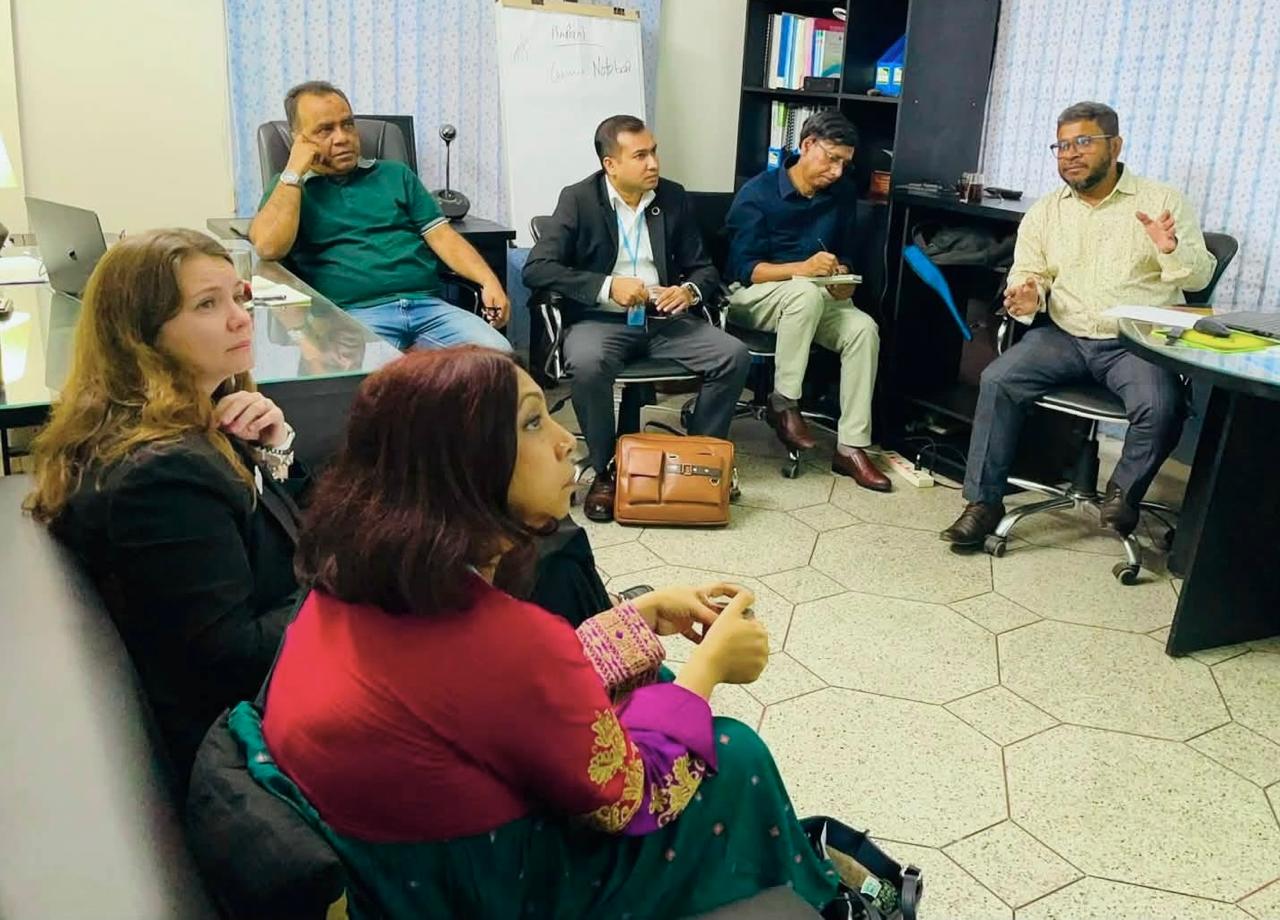
Project: Survey on Bangladeshi Migrant Workers and Returnees from the Gulf Cooperation Council (GCC) Countries on Access to Social Protection at Destination and Upon Return.
Partner: International Labour Organization (ILO)
Services: Mixed-methods social protection survey, Quantitative and qualitative data collection, Computer-Assisted Telephone Interviewing (CATI) survey implementation, Assessment of migrant workers' de facto access to social protection, Gender-sensitive and intersectional analysis.
Duration: July 2026 - January 2027 (ongoing)
Addressing the problem, migrant workers often face a gap between what their legal entitlements to social protection are and what their actual access to benefits is. In the context of Bangladesh, the country has expanded its social protection system through the National Social Security Strategy (NSSS) and migrant insurance schemes; however, the limited effectiveness, coverage, and adequacy of these schemes are evident. According to the evidence gap, which limits evidence-based policymaking and programme improvement, the need for research is to understand migrant workers’ actual access to social protection (de facto) across their migration cycle.
DEVCOM has been engaged under the ILO STREAM Programme by the International Labour Organization (ILO) to conduct a comprehensive mixed-methods study on access to social protection for Bangladeshi Migrant workers across the migration cycle. The study aims to combine a large-scale phone-based quantitative survey of returnee migrants with qualitative research, which will examine the vulnerabilities, experiences, and access to benefits across nine social protection contingencies. These findings will support the development of inclusive, gender-responsive social protection measures, including strengthening data-driven policy dialogue and programme design, across the South Asia-GCC migration corridor.
DEVCOM will contribute to this initiative with the following activities:
- Survey design: Generating the inception report, which articulates the sampling design, research methodology, planning field procedures, and detailed workplans.
- Questionnaire development and survey preparation: Conducting the questionnaire, translating, configuring, and testing a mobile data collection system, and pilot testing.
- Data collection: Training of enumerators based on the sampling plan for quantitative phone-based interviews, conducting interviews using CATI platforms, ensuring data quality and monitoring
- Data analysis: Analysing data through merging all CATI submissions into a master dataset and conducting systematic cleaning, verifying key variables, computing and calibrating design weights, statistical analysis, and segmentation.
- Reporting and dissemination: Delivering the final quantitative datasets, drafting a short quantitative report with socio-economic profiles and key observations, a final synthesis report combining key quantitative findings, tabulations, and major findings on factors influencing access to social protection along trajectories of different types of migrant workers, presentation and dissemination workshop.